Standing Rigging Definition: It is comprised of fixed lines, wires, or rods that are designed to support each mast or bowsprit on sailing vessels. These specific components likewise reinforce the spars against increased loads when wind interacts with the sails.
Running Rigging Definition: is the rigging of a sailing vessel that is used for raising, lowering, shaping and controlling the sails on the vessel.
One part of yachts that must be inspected regularly, maintained, or even replaced when necessary is the standing rigging. It is not only a requirement of your insurance it is a necessity for the safety of the vessel. Inspections should be considered annually to check the condition of the rigging. Any issues with the standing rigging if not maintained correctly and quickly can result in rigging failures such as de masting. Your insurance provider might be a little reluctant to payout if you have failed to inspect and maintain your rigging appropriately. It is the belief that if your rigging is new or only a few years old there are no problems and a rigging check is not required. On the contrary, rigging failures can happen for all sorts of reasons and many are not due to the age of your standard rigging. We have just finished our “Rigging Inspection” on Our Dreamtime and we will go through what was inspected and any tips our rigger gave us to lookout for. Our Dreamtime is a cutter rigged ketch so if you want to know about rigging I think we could cover 99% of rigging requirements.

Normally, the replacement of standing rigging should be done every 10 years. Generally, insurance companies today require the standing rigging be replaced approximately every 7-10 years, depending on how often, or how far the yacht is sailed, they may require the rigging to be replaced earlier than 7 years. (Check with your insurance company, as policies may vary) Insurance companies also commonly request a professional rigging inspection and survey of the yacht when a used boat is sold or if a new policy is to be obtained. It is not written that a rigging check is required annually so why do it? For us it is piece of mind, we regularly service our engine but in comparison to the hours we use the engine compared to sailing hours we feeling that our rigging needs as much or more attention than the iron horse.
When conducting inspections, you can easily identify components that require repairs and replacements. Many of these routine inspections can be completed by you when cleaning the boat. So, a good visual rig check where you can move each component around can go a long way to identifying potential problems. Checking to see if D-Shackle pins are correctly bedded or that the tea leafing isn’t turning into rust are a few of the items you can check whilst cleaning but here are a few more to add to that list
Halyard Swivels: Oiling halyard swivels makes releasing clips or removing twists in rope easier and smoother.

Sail Tracks: To make hoisting and lowering sails easy and smooth, it is a good practice to spray the tracks or bolt rope with some lubricant, we a silicon spray that stays extremely slippery after it dries.

Furler Bearings: Greasing furler bearings is quick and easy and makes furling sails in and out a breeze. Make sure to drop the sail to grease the bearings in the swivel and in the drum.

Sheaves: Sheaves in the mast, on the deck or in blocks should be oiled, so they run smoothly, preventing corrosion and seizure of the bearings.
Split Pins and Split Rings: Checking split pins and split rings is important to prevent clevis pins from falling out and leading to catastrophic failures. Checking for sharp edges in these is also important to prevent the sail from catching and potentially ripping. We recommend using mousing line or small zip ties to secure pins helping them to stay in place.
Uniform Load Bearing ULB: A uniform distributed load is a force that is applied evenly over the distance of a support. For the least amount of deflection possible, this load is distributed over the entire length of the support. For example where your shrouds meet your deck plates.
However the real tests need to be done professionally by a qualified rigger. The rigger should be checking all of your fittings, standard rigging and running rigging from bow to stern, from mast top to deck level and if your chain plates are visible these need to be thoroughly inspected. If they aren’t visible try to make them visible for the inspection. Other components that must be checked for any damages, universal load bearing, load percentage or performance issues include swivels, back and forestay fittings, tang plates and toggle fittings, shrouds, swaged terminal ends, mainsail track, spreaders, turnbuckles, blocks, sheaves, and spars etc.
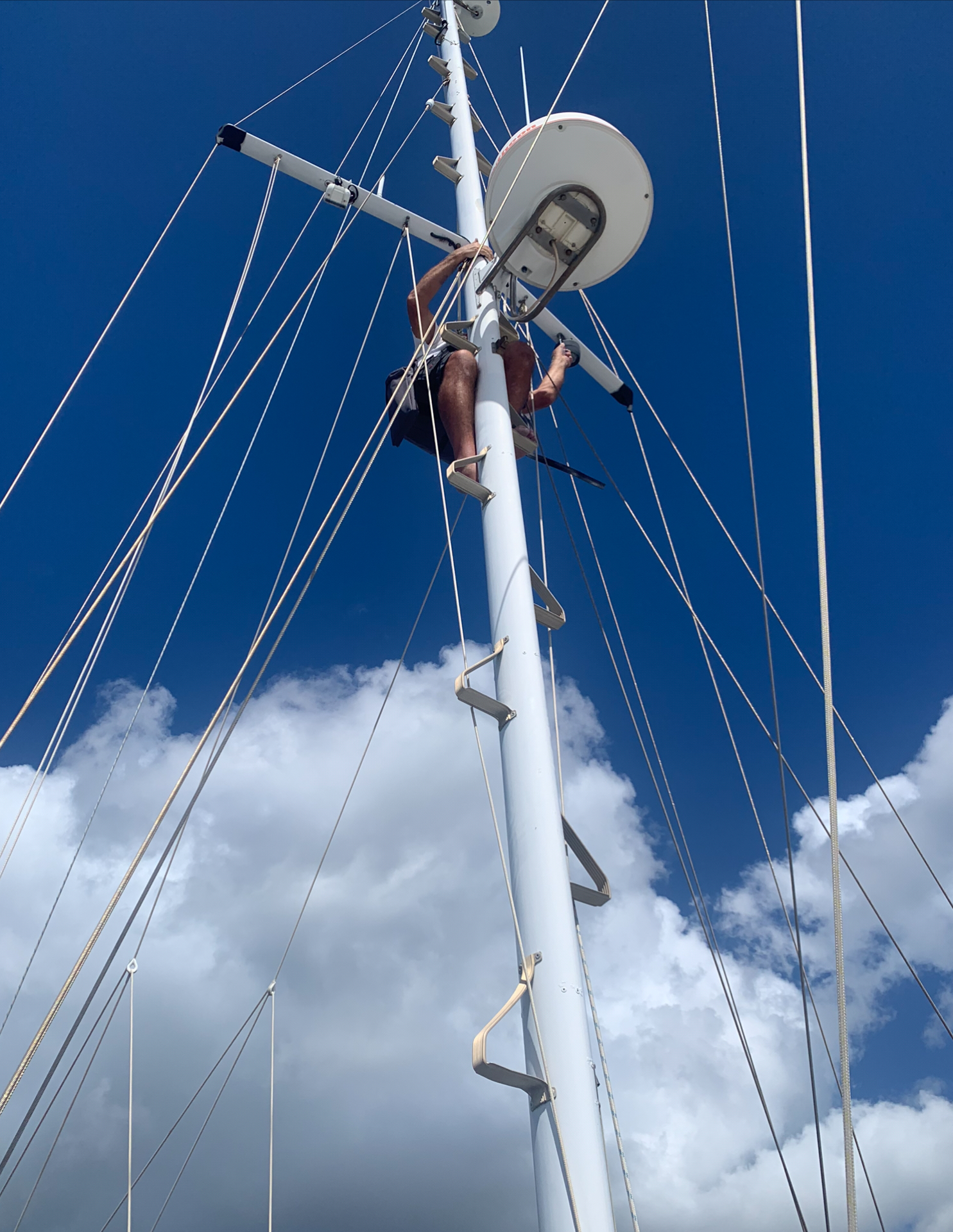
When carrying out standing rigging inspections, riggers need to go up the masthead. Looking closely for any signs of corrosion, cracks, or breaks of any kind in the standing rigging (ei. In the wire, terminal ends, rod, toggles, pins, backing plates etc.) as they descend the mast all connections to the mast are inspected such as spreaders, spars, etc. Once on the deck all of the deck fittings are inspected and load tests are made on each shroud. You may have an original rigging diagram from when you boat was rigged it is important to have this on hand so the rigger knows the load requirements.
Components that have either corroded or have obtained cracks and damages should be replaced right away to avoid compromising the whole standing rigging. There is really no compromise when it comes to your rigging.
What if you are told the rigging needs replacing. In our mind there is no option but to replace. When we purchased Our Dreamtime the survey said that they couldn’t put an age on the rigging some areas were in need of repair. We spoke with our insurance company and we both agreed the boat needed to be rerigged. We were fortunate that new negotiations were made with the seller to reflect this. Once re-rigged we could renegotiate our insurance level.

So how should you re-rig if required. The most efficient and cost-effective way to replace the standing rigging to a yacht is to remove the entire mast and rigging from the yacht. This way you can do all the stays at the same time, you can make the pairs the same lengths and it is also much easier to check over the whole mast and make any repairs and replacements where needed. Every standing rigging component from the top pins to the bottom pins, and everything in between should be replaced, so there isn’t any weak link. Chainplates should also be removed inspected and tested. You can spend all the money on new rigging and if you don’t check your chainplates it like putting up a circus tent with plastic pegs.

The alternative is replacing the standing rigging while the mast is in the boat, you have to support the rig systematically as they de-tension, remove, make and replace individual stays to the mast. This is a very time-consuming process, because it involves a lot of mast climbing, making individual stays and tensioning and de-tensioning, it can seem like the best and easiest way to do it but is it doing a complete job.

Now when it comes to running rigging this is replaced continuously, I don’t think there is a line older than 3 years onboard Our Dreamtime. This is also part of your rig inspection. Your running rigging works intricately with your standing rigging. Regardless of whether you sail a modern, fractional-rigged sloop or a wishbone-rigged staysail schooner, it’s the running rigging that sets, trims, reefs and furls the sails. Every ball- and roller-bearing block spins like a roulette wheel when there’s no load on the sheave. But when you add hundreds, even thousands, of kilograms of tension to a halyard or sheet, they are the weak point and can easily fail if not maintained. So to is the condition of those halyards or sheets, if they are not maintained they can cause malfunctions to your standing rig.

We have come along way in our cordage. In the bad old days rough heavy ropes and sunbathed muscled men were used to haul up those sails, but today, various types of synthetic- fiber cordage, with specific strength, stretch and creep characteristics, run through ultraslippery blocks, winches and fairleads. Even the halyard hardware that attaches the line to the head of a sail has been computer-modeled and scrutinized with finite element analysis. Soft shackles and strops, made from Dyneema fiber rope, are showing up in high-load locations. In short, we are in the midst of a running-rigging revolution, and much of the new stuff offers real value to the cruising sailor. So what should we be using? Well again this is where your professional rig inspection can be of great use. We currently have a mix of standard stainless standing rigging and dyneema and we were able to ask the questions of our rigger on whether we could change some of the stainless and hardware to dyneema. To our delight some of the deck snap shackles can now be swapped out for soft shackles made of dyneema. This isn’t to say they are fail safe but they are kinder on toes and our hip pocket.
So back to how you can check your running rigging and maintain it. Ironically, cruisers don’t need the highest-tech line, but we certainly do benefit from well maintained line. Manufacturers have all faced claims of rope failure and most of it can be avoided by us maintaining our equipment.
Wash your lines, yep give them a bath. All manufacturers recommend some type of cleaning. For the first few years, ropes still contain thread coatings and lubricants from the factory that provide easy handling, as well as offer some protection from UV radiation, abrasion, and water absorption. We like to do ours annually, when the sails are being serviced the lines get a good bath. Now we have heard of lots of pillowcases being filled with “sheets” (lines). If you read some of the manufacturers comments double-braid (what cruisers use mostly) is subject to herniation and destruction during the machine-washing process. So really all you need is a bucket full of fresh water and we like to use baby shampoo no nasties for your lines or the environment. Wash and soak for 24 hours and then rinse well and sun dry hanging up. In between this thorough clean, a regular rinse when giving the boat a wash down, rinsing removes salt crystals and will help to reduce wear and tear (chafing).
End for End. Now that they are nice and clean reverse them use the end that’s been in the rope bag for most of the season to now attach to the clew, head of the sail or furling drum.
Whip and melt the end of every rope before use. Karen seems to love this job, apparently it is very satisfying but it really has a benefit to your lines. Whipping tightly binds the line’s fibers near the end. Because the line end actually becomes smaller when compressed beneath the whipping, the line will not bind in blocks or other sailboat gear. The centre core is also held tightly with the outer sheath and won’t seperate over time. All you need is whipping twine (usually a waxed synthetic) and a large needle to get started. After whipping we generally fuse the end with heat.
Checking for Chafing isn’t something that you do annually it is done all of the time. The friction between a rope (rode, sheet, halyard, etc) and another object will cause abrasion or chafe. This is a very serious issue as it significantly weakens the rope until it parts – often with catastrophic results. Chafe can occur very quickly with your lines and dock lines. We have seen halyards, sheets and furling lines all break. Any rope that touches edges or is exposed to objects that can rub (including other ropes) runs the risk of chafing through. Adequate protection against chafe is essential. If we find chafing even the slightest amount we rectify it by moving the line, checking on why it is chafing and repairing the line with whipping. Prevention is always the first solution if you know of an area that chafes for example your dock lines use a chafe guard. If you have an area on the boat that you lines rub against again use a chafe guard but constantly checking your lines is the best preventative.
We filmed the rigging inspection of Our Dreamtime and you can see it on YouTube Episode
⏩ https://www.youtube.com/watch?v=q5QNmvDsBS8
We hope you have gained some knowledge and information from this blog.
This is not an advertisement we were not sponsored by the rigger. We paid as a customer. But we are extremely happy with the work and the report Darrin Carter provided. However what we are most pleased with is how thorough an inspection was carried out. How professional he was and how he explained each of the areas we could improve, maintain or replace. We had been trying to get a rigger to the boat since January 3 said they would come, not one of those three turned up or have returned our phone calls. We also have had rigging inspections before that have not gone up the mast, now you can’t be confident in that! Our advice is before engaging a rigger you find out what they cover and does it include an insurance certificate as most don’t.

Happy Sailing everyone Cheers R&K
You maybe also be interested in the following 🔽
We found paradise but we may never leave as our anchor is stuck solid. You can watch it here.
▶️ http://tinyurl.com/DreamtimeSailEp87
If you are travelling to Indonesia by boat you maybe interested in the following guides.


This interactive Ebook takes from Brisbane to Horn Island without a night passage, discovering beautiful parts of the Queensland coast rarely visited. The EBook supplies all of our tracks and anchorage waypoints, with what anchoring conditions we were in. But it also gives you full details of what to see and do at each remarkable destination.
You can find out more about this EBook here ▶️ https://payhip.com/b/pxLMX

Is this your first time into Indonesia? This amazing country has so much too offer the cruiser. What we can say is sometimes paperwork can be overwhelming. This interactive guide is to help you wade through the
officialdom and come out the other side without tearing your hair out.
You can find out more about this guide here ▶️ https://payhip.com/b/YEeQ7
If you would like to buy all 4 of the above EBooks to help your sailing journey you can at a discount. Because you have read to this far on our blog, as a thank you we say here’s 20% off the bundle price!
So head to our book store ▶️ https://payhip.com/Dreamtimesail
and use this code at checkout ▶️ WOTZCNM6JL