Dreamtime Sail

Dreamtime Sail

Friday, 24 May 2013

Bye Bye Barcelona, Hello Menorca


May 8 -10, 2013

 After a fantastic stop in Barcelona we were set to finally leave the Spanish mainland and make the 140 nautical mile crossing to the island of Menorca on Tuesday May 7. Well we thought we were set. As we were making final preparation to cast off we discovered a slow leak we’d been suffering from our water heater tank was now more like a small torrent filling our bilge with wet stuff. There was no option but to delay our departure and effect immediate repairs.

 
In a piece of ludicrous design, the heating element fits in the side of the tank rather than the top as is usual on domestic hot water systems. The tank is also positioned in a very tight space under one of the salon seats so you need to be a contortionist to reach the element fitting on the tank’s far side and then work on it almost entirely by feel alone.

We’d had a new heater element fitted back in Gibraltar to replace the burnt out one that had begun leaking on our way west along the Spanish coast. We thought paying someone who ‘knew what he was doing’ was wiser than blundering on ourselves but we did watch on closely to see how it was done for future reference. Unfortunately by the time we reached Estepona on the return trip we discovered water was leaking again very, slowly from around the element. Marc had brought a new replacement with him back from the UK and while in Barcelona we had swapped them over but, as it now appeared, not with great success.


On our first day on Alcheringa a cruising friend messaged us saying ‘Congratulations on getting a boat. Now go and fix something.’  This hot water tank is fast becoming the bane of our fix its.

A fellow Aussie cruiser we’d met in the marina happened to be a plumber and with the leak reappearing in an even more dramatic fashion he recommended that rather than trying to work on it in its very confined space, we take the tank completely out and find the cause of the problem once and for all. Forty-five minutes later the recalcitrant boiler was sitting on the dock. It transpired that the element had been cross threaded back in Gibraltar. The replacement we had put in had simply followed the crossed thread and not seated well enough to seal when under pressure. Now with easy access to the fitting we were able to clean up the thread and properly fit the element.  The tank went back in place and by mid afternoon everything was ready to test. We were disappointed to discover a very slow weep of water still appearing down the tank’s side but fortunately it was not enough to delay our departure any further . A permanent, 100% solution would have to wait.

The following morning we cast off early, made a stop at the fuel dock to top off our tank before clearing the harbour breakwaters just after 9.00am. The weather forecast indicated we’d be right in the middle of a massive high pressure system with no wind at all for our entire crossing and that’s exactly what transpired.


Goodbye Barcelona and the Spanish mainland. Next stop Mahon on the island of Menorca.
We motored across glassy seas all day and into the night alternating on three hour watches. Our boredom was broken by an almost constant parade of marine life in strong contrast to most our experience in the Mediterranean. In almost twelve months of trying we’ve caught one fish and now generally consider the Med a marine desert, almost devoid of life as a result of centuries of over fishing. 


You know the sea is truly calm when a passing jet’s contrail is reflected on the water.
However on this day we motored through a school of large tuna chopping their way through bait fish within an hour of leaving Barcelona. Unfortunately they were not interested in our lure though so our fishing drought continued. We were also entertained by scores of sunfish basking on the surface with their fins protruding above the water.


It’s a pity the camera doesn’t see into the water as well as the human eye as
these sunfish are such strange creatures but cool to watch basking on the surface.
Next a school of dolphins paid us a visit and played briefly around the bows before disappearing into the distance. A couple of hours later we were surprised to spot a humpback whale crossing our course half a mile or so ahead of us. We’d seen two of pods of whales early last year while crewing on Moksha but this close encounter was still very much unexpected and had us all on a high. No sooner had we got over our humpback surprise than we were stunned to see a large pod of Orca surface off our port beam with their distinctive high dorsal fins arcing through the air. It was amazing to watch them speeding through the water seemingly on a mission and totally disinterested in our presence. It was only midafternoon but we’d seen more sea life in a day than we’d witnessed in the past year and began to wonder what on earth could be next on mother nature’s agenda.
We didn’t have to wait too long as a small bird flew across the cockpit closely past Karen’s ear, down through the companionway and settled on the couch in the salon. We were now around 60 miles (110 kilometres) from shore yet here was a land bird hitch hiking on our boat. Rob put some water in a saucer for our wayward little friend as it was clearly exhausted and not even able to stand. Expecting he/she to take quite a while to recover some strength,  we all stayed on deck so as not to scare it but within fifteen minutes or so it flew up into the cockpit and perched on the table beside us. We thought it had decided to join our crew for a while but soon took off again to resume its journey. We hope it made landfall safely but have our doubts.


Our hitchhiker made the most of our hospitality to recharge his batteries before flying off again.

After an uneventful night Rob was treated to a spectacular sunrise on his 3.00 to 6.00am watch as we made our way down the east coast of Menorca towards our destination at Mahon.


A Menorcan fisherman brings in his nets in the pre-dawn light.

We’ve seen some spectacular sunsets and sunrises since heading off to sea but this was right up amongst the best of them.
Entering through the heads and passing the fortresses into the harbour at Mahon was spectacular. Lord Nelson described this as the best natural harbour in all of the Mediterranean if not the world. It is pretty good but Nelson never saw Sydney Harbour so he can be forgiven for his mistake.


Puerto de Mahon is protected from the weather by some very impressive cliffs.

Our Spot Tracker Google Earth image shows where we moored and why Lord Nelson rated the harbour at Mahon so highly. His entire fleet fitted in safely with plenty of room to spare.
We had emailed ahead from Barcelona to Marina Mahon to book a berth and now ambled slowly around the harbour as we spent twenty minutes trying to raise them on the radio for instructions as to where to go. We finally gave up and rang their phone number and were told their mariners would call us on the radio in five minutes. Ten minutes later with still no radio call we were passing the town wall when we spotted a guy on the dock signalling us to moor stern to right there. We figured we were being high-jacked by an opposition marina but quite frankly didn’t care by this stage. Minutes later we were securely berthed in a fantastic spot right in the centre of things.


Alcheringa nice and snug in the centre of things. We’ve come to really enjoy town wall moorings much more than normal marinas.
 We quickly learned our dockside helper was Alberto of Sunseeker Moorings who not only ably assisted with our lines but proved to be very welcoming and a mine of information. We were very pleased he had spotted us and stolen our business. (Our marina review will be in the next post) Marina Mahon never did radio us back.

The view around the harbour from Alcheringa was breath taking and we were just metres from shops, great cafes and restaurants. We squared everything away, washed the boat down, enjoyed a good hot shower and then headed into Alberto’s recommended establishment for a menu del deia (Menu of the day) for lunch and a well deserved post passage drink.


Barcelona to Puerto de Mahon 145.5 Nautical Miles – 24 Hours 30 minutes  Average Speed 5.9 knots Maximum 6.7 knots
 
To stay right up to date with what we’re up to these days and see lots more photos check out and 'like' our Dreamtime Sail Facebook page at Dreamtime Sail on Facebook
If you have only recently discovered our blog and would like to read how it all started, or work through our previous adventures, click the link to go back to our first blog entry. Stuff it. Let's just go sailing anyway.  We hope you enjoy reading the previous posts to catch up on our story.


Saturday, 18 May 2013

Bella Barcelona

May 4 -7, 2013

 Everyone we ever spoke to about Spain said ‘You HAVE to go to Barcelona.’ After spending a few days in this remarkable city we are in total agreement with them all.  Where as elsewhere in Spain you cannot avoid the pervasive sense that you are in a country undergoing severe economic hardship with empty restaurants, closed businesses and stalled construction projects seemingly on every corner, in Barcelona, and in fact the entire Catalonia Region the first thing that strikes you is the vibrancy of the streets. This place is booming.

The cafés, restaurants, bars and tourist busses are full to overflowing despite us being in town well before the peak summer season. The redeveloped harbour area is packed with literally billions of dollars worth of super yachts and humming every day with big crowds wandering the beautifully developed, pedestrian friendly area and its numerous attractions. Even the buskers are doing well.

Barcelona was everything we expected and more.
 
Our marina was right in the middle of all this action and after exploring the fantastic area around us it was time to venture further. Despite normally avoiding tourist traps like the plague we decided the best way to get an idea about Barcelona itself might be via the ubiquitous open top tourist busses that range around the city’s attractions. SCORE!!!! On the bus you’re provided with headphones to access a running commentary in your own language of what you’re driving past and there’s even free WiFi so you can get your emails and post photos of what you’re seeing on Facebook on the go. The book of discount vouchers for various attractions around town is also well worthwhile.


The tourist bus did in fact prove to be an excellent experience

The old city area of Barcelona is full of architectural marvels


Twenty-six Euros buys you an unlimited jump on jump off pass covering three routes through distinctly different areas of the city. An even better idea is to pay the extra Seven Euros for a second day. This, and an early start, allows you to ride the three available routes with minimal stops getting a very good overview of this amazing place and mark the places you’d like to explore more fully. Then it’s just a case of jumping back on the big red bus the following day and working through your to do list. (If you can fit it all in)
 
 
THE absolute must do of course is the world’s most incredible church. The Sagrada Familia (Church of the Family) is a work in progress so to speak. It was actually started in 1882 as the brainchild of illustrious Barcelona architect Antoni Gaudi. After 130 years it is still far from finished yet has already been listed as a UNESCO World heritage site. It only officially became a church in 2010 when it was consecrated by Pope Benedict XVI. 2010 also marked the project passing the halfway mark so if you plan on seeing the completed project you’d better start living healthy, very healthy in deed. The scale of the building has to be seen to be believed. When finally completed the highest of its eighteen spires will be 170 metres (560 feet), one metre less than Barcelona’s Montujic Hill because Gaudi believed man’s creation should not surpass God’s.


The Sagrada Familia towers over Barcelona


Describing Sagrada Familia art critic Rainer Zerbast said ‘It is probably impossible to find a church building anything like it in the entire history of art.’ Rob described it as the world’s most stunningly ugly building. Whatever it actually is, it has to be seen. But don’t miss the city’s actual Cathedral. It may be more conventional but is a beautiful building with incredible detail wherever your eye falls. In fact a stroll around the old city of Barcelona gives you a sore neck as you continually swivel your gaze from one amazing vision to the next dramatic feature.
 

We actually felt the Cathedral of Barcelona was far more beautiful than Gaudi's church


The 1992 Barcelona Olympics may be a long distant memory for most of us but the lasting legacy the event has provided this Spanish city cannot over stated. The 11.4 Billion Dollars spent redeveloping the sea front and building the games facilities combined with the history rich old city has turned Barcelona into one of the most popular tourist destinations in Europe and a far cry from the industrial backwater of the Franco era.

Don’t take our word for it. Put Barcelona firmly high on your ‘bucket list’ and go and have a look for yourself. You won’t be sorry.

MARINA REVIEW: Port Vell Marina Barcelona ****1/2


Cost per night for our 43 foot (13.2m) yacht – 50.60 Euro (plus metered water and power.  WiFi provided but only available in a small demountable building on the docks)

The Marina is well within huge harbour providing100% protection from any weather.  It is a perfectly located  base to explore Barcelona from. Shower facilities are very regularly serviced and extremely clean. They also include token operated laundry facilities within. Very well stocked chandleries are nearby and all possible boat services are available within the harbour. The range of restaurants, bars, cafes etc within walking distance is almost limitless. A major shopping mall with massive supermarket for provisioning is within a 5 Euro taxi ride. We considered the mooring price excellent value for money considering the marina’s location and facilities. But be quick. The marina is undergoing a massive billion dollar redevelopment to turn it into the Mediterranean’s top Super Yacht port and berths for little guys like us are disappearing almost daily.

We gave it four and a half stars. If we owned a Super Yacht we’d probably give it five.


To stay right up to date with what we’re up to these days and see lots more photos check out and 'like' our Dreamtime Sail Facebook page at Dreamtime Sail on Facebook
If you have only recently discovered our blog and would like to read how it all started, or work through our previous adventures, click the link to go back to our first blog entry. Stuff it. Let's just go sailing anyway.  We hope you enjoy reading the previous posts to catch up on our story.


Monday, 13 May 2013

Moving on again, Valencia to Barcelona

 May 1 - 4, 2013

 After the wild weather that had kept us confined to the marina at Valencia, the new month of May dawned with mostly clear skies, no wind and flat seas. We were now looking to catch up a bit of lost time so instead of the planned very casual, six days of short hops along the coast to Barcelona we had upped the pace with longer runs cutting the trip to four.


Heading into the sunrise from Valencia
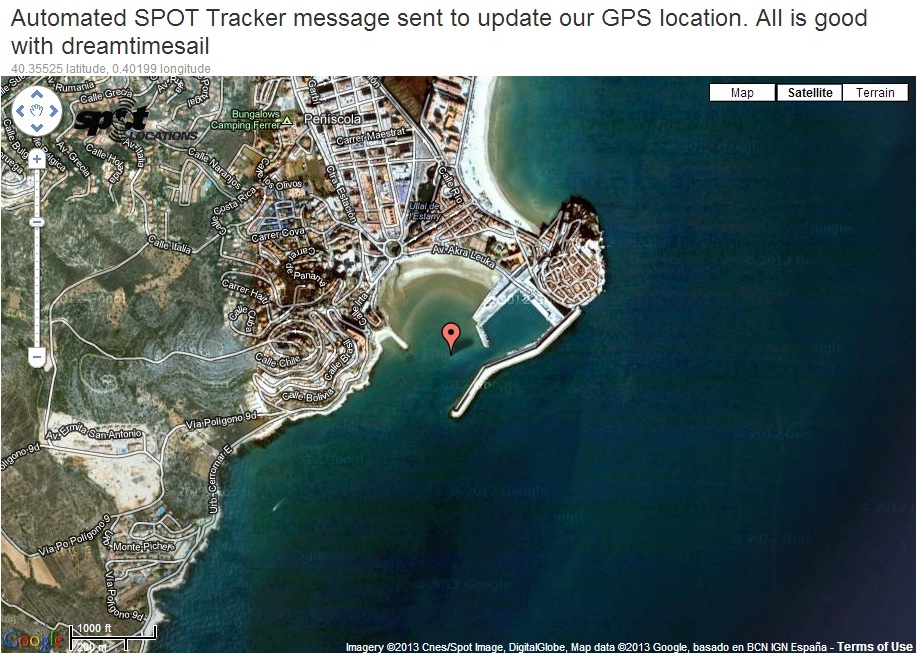
As a result we cleared the breakwaters of Valencia’s Marina Real Juan Carlos 1 shortly after 7.00am and motored north for an uneventful, 63.3 nautical mile trip to a delightful anchorage behind the breakwater but just outside the small fishing harbour at Peniscola. (Yes, that really is the name of the place). We arrived in plenty of time for a nice relax in the cockpit just off the beach and admire the beauty of the traditional buildings lining the sides of the steep headland which was topped by its crowning glory, the Castilo del Papa Luna. The soft, late afternoon light certainly presented the scene at its best.


Karen takes a pic of the castle for our electronic log on the I-Pad.

Valencia to Peniscola -  63.3 nautical miles - 11 hours  25 minutes
Average speed 5.5knots,  max 7.2 knots

We're always on the lookout for anchorages like Peniscola where we can drop behind the protection of a nice breakwater

The bay in Peniscola is a little shallow and we anchored in under three metres of water but  it proved an excellent and very calm anchorage for us. We were all well rested when we rose with the sun and rounded the cape and its spectacular fortress to continue our journey. If the water was calm at dawn, by mid morning it was like a sheet of highly reflective glass with not as much as a ripple to mark its surface.  Our trusty 75hp Yanmar diesel was again providing our forward momentum.


It was about as calm a morning as you can get as we left Peniscola
 

A mild wind did appear in the early afternoon but typically it was coming from almost the exact direction we needed to go so the engine stayed on. As we approached Cabo Tortosa at the mouth of the Ebro River delta the wind began to build which was contrary to every forecast we’d looked at. 


Cabo Tortosa is the flat point at the right of the photo
The Ebro is the largest river in Spain depositing a huge amount of silt which, over the centuries, has built up the delta  of many small islands separated by channels, saltpans, swamps and mud. In some places the shore is reputed to be advancing seaward by 10 metres a year.  The pilot guide book  advised that ‘The shore line of the delta is probably the most dangerous section of this coast.  Tramontana NW gale can come down the Ebro valley with considerable force and little warning. Altogether, from the point of view of a navigator, it is a place to be avoided.’ It strongly warned against cutting the corner around the cape so we had plotted a course well offshore which provided us with secure margin of safety. This proved a wise move as, sure enough, we ran head first into one of the Tramontana winds the pilot guide had spoken of as we turned the corner towards our anchorage in a small bay off the beach at Playa de Roig. It was nowhere near as severe as this wind can get but bashing head first into 30 knots and a short, sharp swell again for the last two hours of our trip was far from relaxing.


Despitewind blowing over the top, Playa de Roig provided a very peaceful anchorage
Fortunately Playa de Roig proved another excellent anchorage in the strong offshore wind and from the time we entered the protection of its low cliffs we found ourselves happily in flat calm. We anchored in clear sand which provided excellent holding. Apart from ruining Karen’s plans to barbecue our dinner of salmon steaks in the cockpit, the wind provided us with no further problems at all before fading out at sunset.

Peniscola to Playa del Roig - 44 nautical miles - 8 hours 33 minutes
Average speed 5.1 knots max 6.1 knots

With a strong offshore wind blowing, Playa del Roig proved a great anchorage
Yet another early start saw us leaving our comfortable bay and heading out into a predicted twelve knot offshore breeze which we anticipated would provide lovely sailing conditions for our run along the coast to our next stop at Puerto de Vilanova. Yeah right. It seemed as if we no sooner got full mainsail and genoa set than our mate, the Tramontana, roared back out of the valley with zero warning. The wind went from twelve knots to near thirty almost instantaneously bringing with it a very agitated sea state.
 

Leaving Playa de Roig pre-dawn we had no inkling what awaited us

It was great to be sailing even if it was a little 'spirited' at times. A few minutes after this shot was taken we were hit with 30+ knots and the reefs went in the sails
We pointed up into the wind to depower all the sails and furled two thirds of the genoa away before going straight to second reef on the main. Despite strong gusts now up near thirty five knots and rough water, the whole reefing process went very smoothly and Alcheringa was soon back on course, leaping over the swells and topping nine knots. We felt quite pleased with how we have got to know the boat and refined our teamwork.


The Spanish version of Homer Simpson's workplace. Nuclear Power.
We passed by two nuclear power stations located on the coast near Cabo del Term. As Australia has no nuclear power, it was a unique experience for us while Marc thought it of only mild interest. We did check each other later that night and are pleased to report that we still don’t glow in the dark so the plant’s radiation shielding must be doing its job.

Our bouncy but rapid progress up the coast continued for the next two hours before the wind began to ease. Marc took over the watch and wheel very much looking forward to helming in the now excellent fifteen to eighteen knot conditions as Rob went below for an overdue comfort stop. Now when you’re wearing a heavy, wet weather, sailing jacket and bib and brace pants over jeans, and sweater, a trip to the loo on a rocking and rolling boat is no quick exercise.  But even allowing for the slightly extended time it took to complete business and redress, he couldn’t believe his ears when he heard the engine fire up. Sure enough, by the time he got back on deck, the wind had dropped to zero and Marc and Karen had furled the rest of the genoa away, centred the main and we were once again, under motor.  No wonder the weather gurus struggle to forecast what’s going to happen along this coast.

We droned along for the rest of Marc’s watch, then to add insult to injury, five minutes after he handed over wheel, the predicted twelve to fourteen knots of wind arrived. Mutterings of ‘not fair’ could be heard from below as the engine went silent and we were able to sail again. This time it only held for an hour or so before again dropping out forcing us to resort to the motor once more.

We had planned to anchor for the night outside the harbout at Puerto de Vilanova I la Geltru but we soon realised that there was too much southerly swell running for that to really be a viable option.. We had no desire for another night of rolling like we’d experienced back off Cabo Cullera so entered the harbour and radioed the Club Nautica for a berth in their marina.
 

Playa del Roig to Puerto Vilanove - 52.3 nautical miles - 8 hours 49 minutes
Average speed 5.9 knots - Max 9.0 knots
(So good when the wind direction lets us sail the rum line)
 

No sign of the swell running outside in the marina
MARINA REVIEW: Club Nautica Marina de Vilanova ***

Cost per night for our 43 foot (13.2m) yacht – 36.30 Euro (Included water, power and WiFi)
Marina inside a largish harbour with very good protection from the elements. The majority of the berths on the pontoons appear to be private or permanent bookings but there are a limited number of visitors berths available. These are located along the concrete wharf. Swing room between it and the adjacent finger is a little tight and the shallow depth and rocks along the edge of the wharf make it necessary to moor bow to avoid rudder damage. The marina was very secure from the swell but otherwise, fairly non-descript.  We gave it three stars.
 
---------------------------------------------------------------------------------------------

Saturday May 4 dawned clear, calm and windless for our relatively short, 27 mile run up the coast to Barcelona. It was such a glorious day in fact that we skirted along the 10 metre depth contour  line hugging the coast and beaches all the way to enjoy the sights.


Spain always throws up scenes that contrast the old and new
Marc had told us he’d had a very scenic train ride from Barcelona to Valencia on his way back to the boat after his trip to the UK and seeing the way the rail line ran along the coast most of the way we could now see what he’d enjoyed it so much. We were also enamoured with the coast road winding up and around the headlands and could imagine how fantastic it would be to unleash our Harley Davidson along this stretch of highway.


It's a pretty cool train ride between Barcelona and Valencia

Oh to let the Harley loose on this coastal highway


Motoring is rarely exciting but we must say it was far from unpleasant moseying along in the sunshine a couple of hundred yards of the long sand beaches and little bays. The constant stream of airliners descending into Barcelona got lower and lower over our heads as they swept over us into the very busy airport.

There are a number of marina options in Barcelona. Port Vell Marina had been highly recommended to us as being superbly situated right in the middle of things very close to Las Ramblas and the city area. It’s located on the north side of the harbour. To reach it we had to navigate two traffic separation zones for the big ships and pass by the entrance to the main commercial shipping harbour. 

 
Once again our AIS (Automatic Identification System) proved invaluable as we adjusted course to avoid a large and quite fast cruise liner, the Costa Mediterraneo, sister ship to the ill-fated Costa Concordia, as it came into Barcelona. It really saved our bacon as we approached the cross over point just outside the entrance channel to the harbour. The height of the huge breakwaters made it impossible to see inside the harbour but a check of our AIS screen showed a container ship was on the move the other side of the walls making for the entrance. We stopped dead in the water just short of the channel and on cue a minute or so later its massive bows appeared out through the entrance not much more than a hundred metres ahead of us. Being run down by one of these big boys would be a sure fire way to spoil your day.


Entering the northern section of the harbour we found it was home to literally scores of massive super yachts of both the sail and motor variety. The whole place was one massive tourist development with masses of people wandering in and out of the numerous businesses and attractions lining the wide docks. Overhead a cable car carried visitors over the harbour and up to the centuries old Castilo de Montjuic looking down over the city from its defensive position high on the nearby hill.


Superyachts of all types everywhere we looked
 
 
We were directed to our spot and berthed with the friendly assistance of two mariners. With all lines on, the engine off and cold beers in our hands, we looked all around us and had to agree. Port Vells Marina is as awesome a location to moor as we’ve experienced on Alcheringa so far.  The marina review will appear in our next post.

We had a couple of days of exploring this magical city planned and couldn’t wait to get started.


Puerto de Vilanova to Barcelona - 26.7 nautical miles - 4 hours 57 minutes
Average 5.4 knots - Max 6.8 knots

 
We love to receive comments on our blog from readers. If you do leave a comment and you also have a blog, please leave a link as well. We'd like to click over for a visit and leave you a comment too.
To stay right up to date with what we’re up to  and see lots more photos check out and 'like' our Dreamtime Sail Facebook page at Dreamtime Sail
 https://www.facebook.com/DreamtimeSail/
If you have only recently discovered our blog and would like to read how it all started, or work through our previous adventures, click the link to go back to our first blog entry. Stuff it. Let's just go sailing anyway. 
We hope you enjoy reading the previous posts to catch up on our story.